

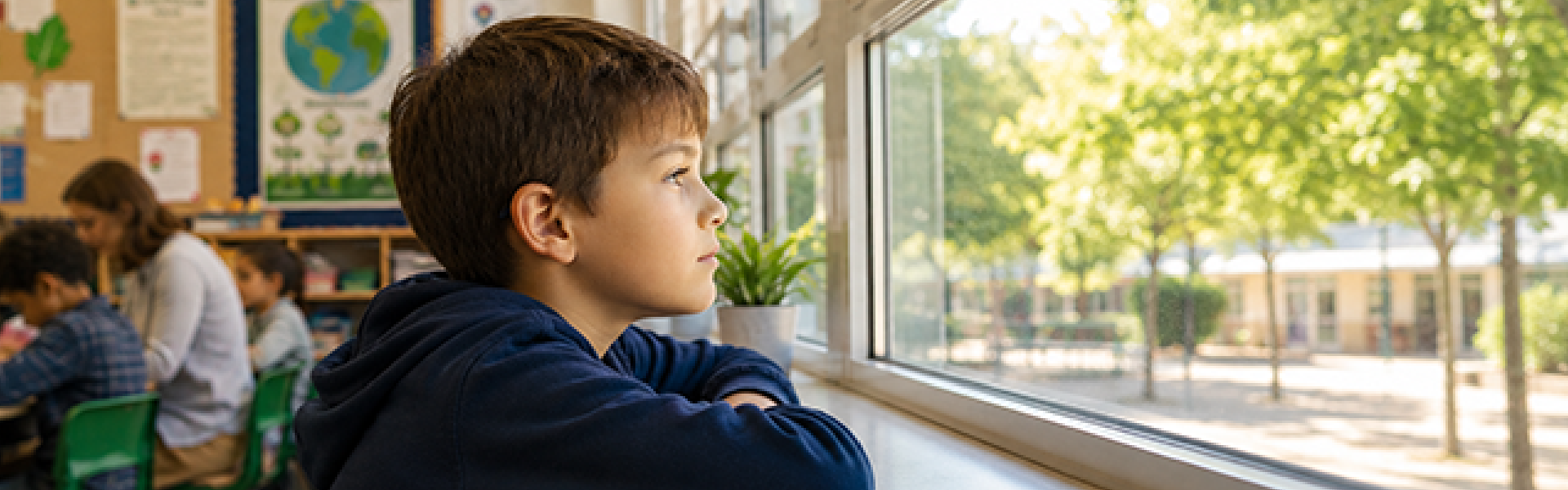
Beyond the Buildings: Why Climate Resilience Must Include SEND
As education settings across the UK prepare for another spell of exceptionally hot weather, leaders will be considering how best to keep children and young people safe, comfortable and able to learn. Ventilation, shading, hydration and indoor temperatures will feature heavily in operational discussions over the coming days, as well as in communications to parents and carers.
This is not simply a matter of summer discomfort. At the time of writing, the Met Office has extended its Amber Extreme Heat Warning, forecasting temperatures of up to 38°C and warning of unusually high humidity and warm overnight temperatures. These are conditions that can affect not only learning environments, but also health, wellbeing and daily routines.
These are entirely appropriate concerns. After all, climate change is no longer a distant environmental issue for the education sector. Increasingly, it is becoming an operational reality. Yet while much of the conversation focuses on buildings and infrastructure, there is another question worth considering. Do all learners experience climate-related disruption in the same way?
For children and young people with Special Educational Needs and Disabilities (SEND), the answer is often no.
Climate adaptation is most frequently viewed through the lens of estates and facilities management…
However, resilience is not only about buildings. It is also about people. For many children and young people with SEND, the challenge is often not the climate event itself. The challenge is the impact that event has on the systems surrounding the child.
For some children and young people with SEND, environmental conditions can have a much greater impact than many people realise. Sensory sensitivities, communication needs, medical conditions and established routines can all influence how a learner experiences extreme heat and other climate-related disruption. What may be uncomfortable for one learner may be overwhelming for another. This does not mean every child with SEND will be affected in the same way. In fact, one of the challenges with SEND is that there is rarely a single answer that fits all needs. However, it highlights an important reality; climate impacts are not experienced equally.
The same principle applies more broadly across the SEND community. Climate-related disruption can affect much more than physical comfort. Many children and young people rely on carefully structured routines, specialist transport, therapeutic interventions, assistive technologies and consistent support arrangements to access education successfully. When extreme weather disrupts these systems, the consequences can be disproportionate.
In many respects, the challenge is not the climate event itself. The challenge is the impact that event has on the systems surrounding the child.
The effects of climate-related disruption are often felt long before a classroom becomes unusable. They can be seen in the operational decisions education settings make every day; adjustments to routines, changes to transport arrangements, altered timetables and communications sent to parents during periods of extreme weather. While these measures are often necessary, they can have very different implications for different families. For some children and young people with SEND, predictability, routine and consistency are not simply preferences but rather important enablers of successful participation in education.
This is also reflected in wider disability and climate research, which increasingly highlights that disabled people can face disproportionate risks during extreme weather events and may encounter additional barriers when accessing services and support during periods of disruption.
For education leaders, this raises an important question. When we talk about climate resilience, what are we actually trying to make resilient? Is it the building? Or is it the ability of every learner to continue accessing education, support and opportunity regardless of the conditions outside? The answer, of course, must be both.
Over recent years, the education sector has made progress in embedding sustainability into its decision-making. Climate Action Plans, sustainability strategies and adaptation measures are becoming more common, reflecting growing recognition that climate change presents both operational and strategic risks. This is welcome progress.
However, there is a danger that climate adaptation becomes disconnected from other priorities, particularly inclusion, safeguarding and wellbeing. Climate resilience and SEND resilience should not be separate conversations.
Governors, trustees and leadership teams already scrutinise SEND outcomes. Increasingly, they are also scrutinising climate risks. The opportunity now is to consider where these responsibilities intersect. Which learners may be most affected during periods of extreme heat? How resilient is specialist provision during disruption? Are adaptation measures being considered through both sustainability and accessibility lenses? Have SEND considerations been embedded into climate action planning, continuity arrangements and other risk management processes?
There is also a wider wellbeing dimension to consider. Through Findel’s partnership with Place2Be, I have seen first-hand the increasing focus being placed on children’s mental health and emotional wellbeing. At the same time, awareness of climate change amongst young people continues to grow. A Greenpeace UK survey found that 78% of primary-aged children reported being worried about climate change, with teachers identifying growing concerns around eco-anxiety and environmental uncertainty.
This does not mean we should shield young people from conversations about climate change. Far from it. Education has a vital role to play in helping children understand environmental issues and feel empowered to make a positive difference. However, it does remind us that climate change is not solely an environmental challenge. It is also a wellbeing challenge, an inclusion challenge and, increasingly, an educational challenge.
That is why climate resilience needs to move beyond the buildings. The true test of resilience is not whether a building can withstand a heatwave, flood or storm. It is whether every child and young person, particularly the most vulnerable, can continue to learn, participate and thrive when those events occur.
As climate risks become more frequent and more visible, the education settings best prepared for the future may not necessarily be those with the most resilient infrastructure. They may be the settings that best understand vulnerability, anticipate disruption and place inclusion at the heart of their response. Because ultimately, climate resilience is not just about protecting infrastructure. It is about protecting opportunity.
Chris Leonard
ESG Manager, Findel
June 2026
Further Reading
Department for Education – Sustainability Leadership and Climate Action Plans in Education
- Met Office – Extreme Heat Warning Extended as Temperatures Forecast to Reach 38°C
- Disability Rights UK – Climate Change and Disability
- National Autistic Society – Sensory Processing
- Greenpeace UK – Majority of Under-12s Worried About Climate Change, Survey Shows
- Autism Parenting Magazine – The Link Between Autism and Temperature Regulation